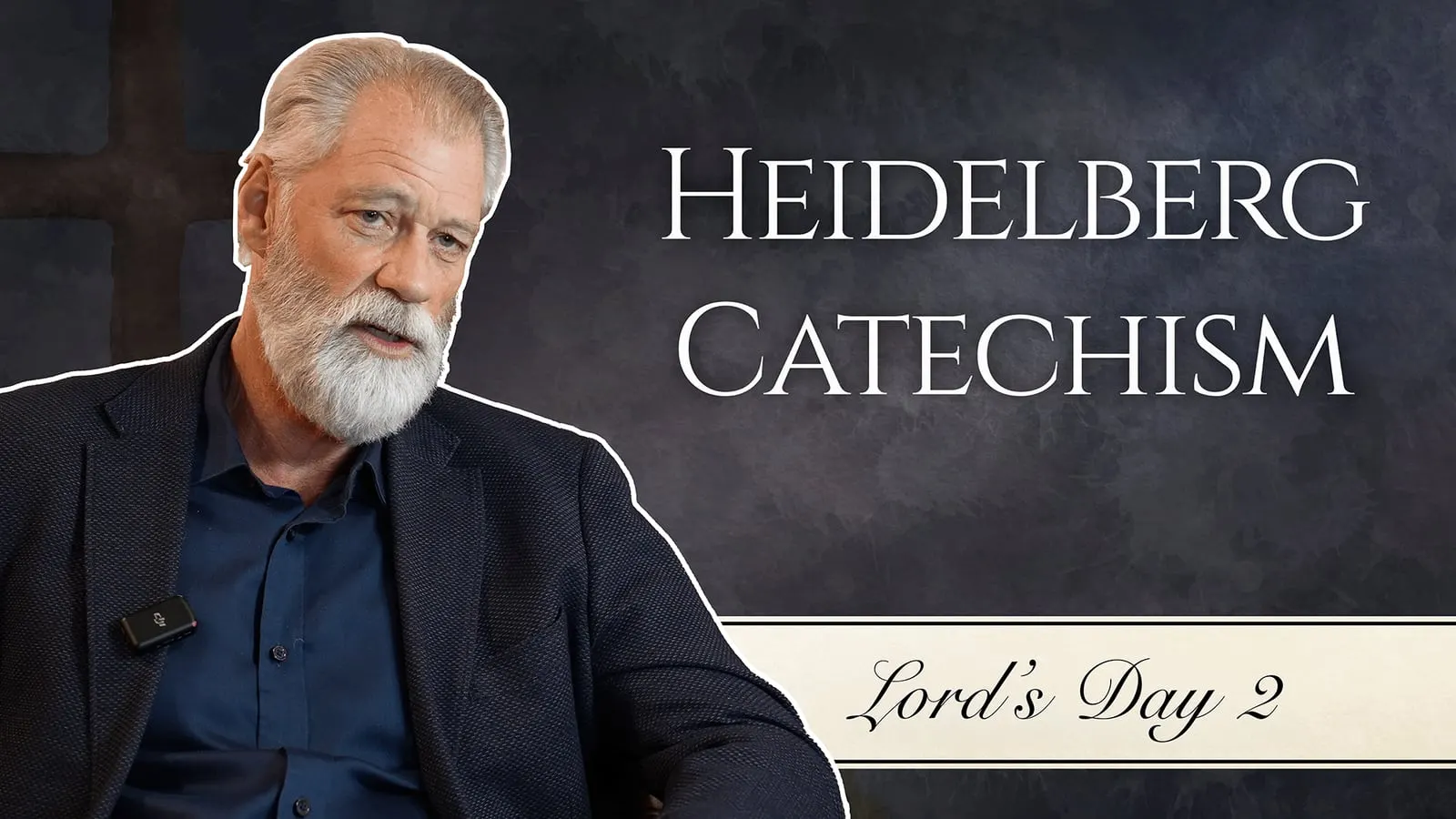
Lord’s Day 2 · The Knowledge of Sin
What does God require of us? Reformed Confessions 8 min May 3, 2025
Taught by
William Pols Cornerstone United Reformed Church, Edmonton, Alberta Read along About Transcript
Q3 How do you come to know your misery?
Q4 What does God’s law require of us?
Christ teaches us this in summary in Matt. 22:37-40
“You shall love the Lord your God with all your heart and with all your soul and with all your mind, and with all your strength.”1 This is the greatest and first commandment. And a second is like it: “You shall love your neighbor as yourself.”2
On these two commandments hang all the Law and the Prophets.
Q5 Can you live up to this all perfectly?
No. I am inclined by nature to hate God and my neighbor.
A growing library of films on the historic Reformed creeds and confessions. The Heidelberg Catechism is complete: all fifty-two Lord’s Days, taught by pastors from across the Reformed churches.
Rev. William (Bill) Pols is the Pastor of Cornerstone United Reformed Church of Edmonton, Alberta.
Free to watch, share and show in your church. Made by Faith to Film with the support of churches and believers.
0:00 Heidelberg Catechism, Lord’s Day 2. 0:13 How do you come to know your misery? 0:15 The law of God tells me. 0:17 What does God's law require of us? 0:20 Christ teaches us this in summary in Matthew 22 verses 37 through 40 you shall love the Lord your God with all your heart and with all your soul and with 0:31 all your mind and with all your strength this is the greatest and first commandment and a second is like it you shall love your neighbor as your On these two commandments hang all the law and the prophets. 0:44 Can you live up to this all perfectly? No. I am inclined by nature to hate God and my neighbor. 0:52 Okay, we've come to Lord’s Day 2, which is the first Lord’s Day in the first section of the Category. 1:00 catechism that concerns our knowledge of our sin and misery. And you recall that that's the first thing that we need to know in order to live and die in true comfort. And though 1:12 this first section is the shortest section of the catechism, that's not the measure of its importance. It is very important. 1:20 for understanding of the gospel. 1:21 Jesus said, "I did not come to call the righteous, but sinners to repentance." 1:26 And for those who come to know their sin, that's good news. 1:29 And this Lord’s Day really deals with one simple point, one simple question, and that is, how do we come to know our sin and misery? 1:39 The first question and answer really addresses that very directly. 1:45 It actually quotes scripture. 1:47 It refers to Romans 3:20 that says, "By the law is the knowledge of sin." 1:53 You know, that's very important in connection with the kinds of things that we might hear people say about themselves. 1:59 it comes to matters of religion. So often people will say, "I'm a good person," or "I try to be a good person." And I've had occasion to respond by asking people if 2:10 they ever heard of the Ten Commandments. And a lot of people have heard of the Ten Commandments, so I say, "Can you name some of them?" And they might say, "Well, you shall not steal 2:19 or you shall not commit adultery or you shall not kill. 2:22 I mean, that'd be pretty good, three out of ten for most people. 2:26 But then I ask them, "Have you ever heard of the first part of the Ten Commandments? 2:31 The first table of the law, it's called." 2:34 And then I explain that the first part of the commandments deals with the knowledge of God. 2:39 and we're to have no other gods besides Him. 2:42 And we're to honor His name. 2:44 We're to worship Him as He has commanded. 2:46 And that exposes what is really the greatest problem that we have, which is idolatry. 2:54 We worship things, or we worship people, or we worship ourselves. That also exposes the problem with relativism. 3:02 You know, a lot of people claim to be spiritual and they might say things that it doesn't really matter what God you serve or what religion you adhere to as long as you're sincere. 3:13 But that's totally man-centered. 3:15 It's a denial of God. 3:18 And the summary of the law which says we're to love God with all our heart, soul, mind, and strength really exposes that. For all of us, who of us can say that we love God with our whole being? No, we want to do 3:30 what we want to do, and we want to do it on our own terms. And that's really what brought the apostle Paul to realize his own sin. 3:39 Our catechism also refers to Romans chapter 7 which says in verse 7, "I would not have known sin except through the law, for I would have not have known 3:52 covetousness unless the law said you shall not covet." That has to do with desires. And he says, "But sin taking opportunity "Opportunity by the commandment produced in me all manner of evil desire." 4:05 It's like the commandment stirred up those rebellious inclinations to want what he wants rather than what God wants. That really exposes the reality of what question 4:19 5 says in its answer as to whether we can keep God's law perfectly, it says, "No, by nature I am inclined to hate God and my neighbor." And that sounds like an exaggeration. But 4:34 the fact is that when compared to the reach of God's law, we see that the natural mind is not subject to that law. 4:45 And in that sense, we hate God because we don't want to worship Him as He has commanded. 4:52 And we hate our neighbor because we put ourselves before our neighbor. 4:55 So this Lord’s Day gives what is called the Summary of the Law. 4:59 law. It summarizes the first table of the law in its demand to love God supremely, and it summarizes the second table of the law in its command to love our neighbor as ourself. But that doesn't mean 5:12 that this summary is like an abridged form of the law or that it's a kind of a reader's digest form of the law? No, the law summarizes or the summary indeed deals with the heart 5:27 of the commandments. And actually Romans 13 makes that clear where it says we're to love our neighbor as ourself and then it says for the commandments you shall not steal, you shall not commit adultery, you shall not 5:39 murder. And if there is any other commandment, it is summarized in this: "You shall love your neighbor as yourself." Love does no harm to one's neighbor. So, 5:49 yes, the commandments can be summarized by the demand to love God and our neighbor, but that also means they can be broken down to the specific commandments. And all their 5:59 details. And those details are especially fleshed out in the third part of the Heidelberg Catechism, 6:07 where the true spirituality of the law is explained in such a way that shows that we fall far short of it. And in fact, that's also the continued use of the catechism's explanation of the law in the third part. 6:27 It asks, "Why must the law be preached and taught so strictly?" And the answer basically is that throughout all our lives we might know our sin and put our trust only in Jesus. 6:39 Christ. And that's a reminder that we need to remember the purpose of the law also way back here in Lord’s Day too. And that is so that we might realize our sin 6:50 and realize that before the law we're under God's judgment and curse. Cursed is everyone who does not continue in all things which are written in the book of the law to do them. 7:03 And in view of that misery, the promise of the gospel shines brightly. 7:09 That Christ was made a curse for us. 7:12 And that in him we have righteousness and the forgiveness of sins. 7:19 you Made automatically from the audio, so a word here or there may be wrong. Tap any line to play from there.
Study Lord’s Day 2 at reformedconfessions.org The full text, Scripture proofs, study questions and quizzes. 



 Now playing3 min

 Now playing10 min
 Now playing9 min
 Now playing13 min
 Now playing8 min
 Now playing8 min
 Now playing9 min
 Now playing9 min
 Now playing9 min
 Now playing6 min
 Now playing9 min
 Now playing8 min
 Now playing8 min
 Now playing6 min
 Now playing11 min
 Now playing8 min