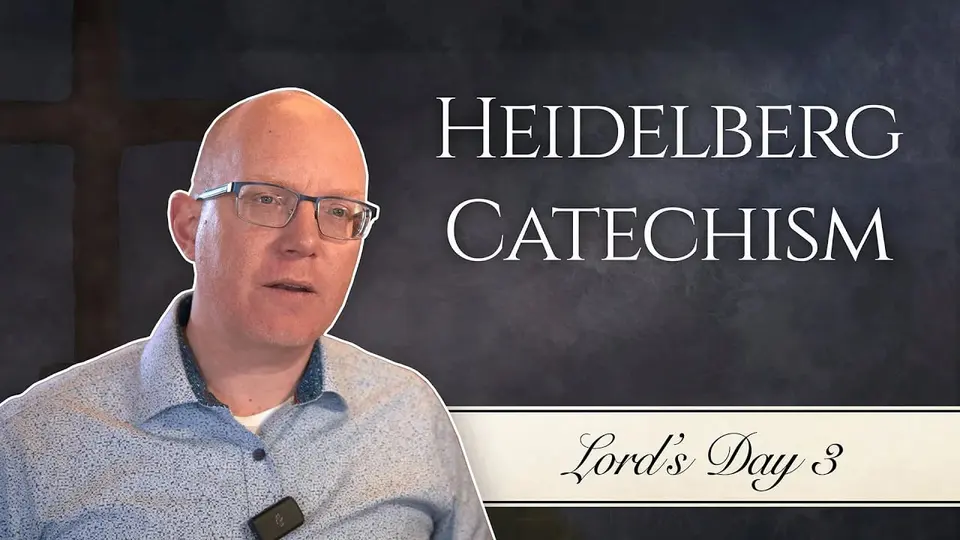
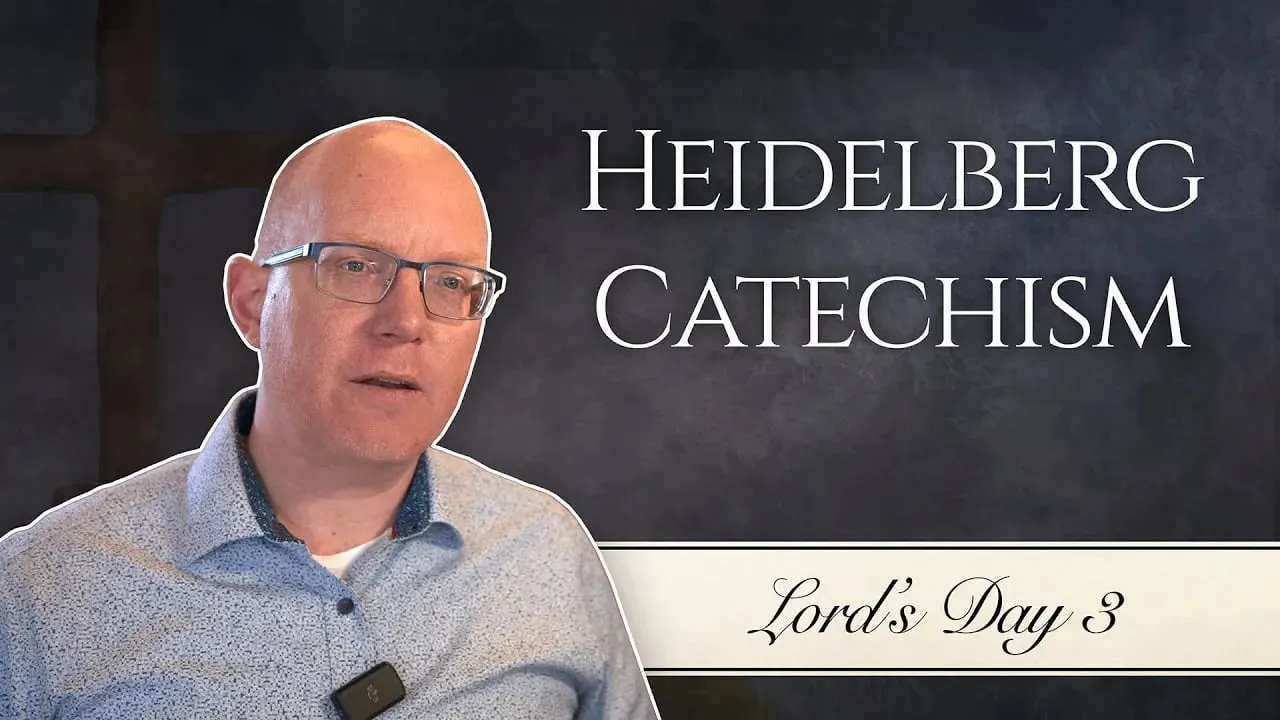
Lord’s Day 3 · The Fall & Human Nature
Were Humans Created Bad? Reformed Confessions 10 min August 30, 2024
Taught by
Jeff Temple Providence Canadian Reformed Church Read along About Transcript
Q6 Did God create man so wicked and perverse?
No. God created man good and in his own image, that is, in true righteousness and holiness, so that he might truly know God his creator, love him with all his heart, and live with God in eternal happiness, for his praise and glory.
Q7 Then where does man’s corrupt nature come from?
From the fall and disobedience of our first parents, Adam and Eve, in Paradise. This fall has so poisoned our nature that we are all conceived and born in sin.
Q8 But are we so corrupt that we are totally unable to do any good and inclined toward all evil?
Yes, unless we are born again by the Spirit of God.
A growing library of films on the historic Reformed creeds and confessions. The Heidelberg Catechism is complete: all fifty-two Lord’s Days, taught by pastors from across the Reformed churches.
Rev. Jeff Temple has been pastor of Providence Canadian Reformed Church since October 2019. He studied History at the University of Western Ontario where he earned an M.A. and Ph.D. in the field of Early Modern European History (1500-1715). His particular area of focus was Reformation History and he has written dissertations dealing with John Calvin’s understanding of church discipline and the pastoral office. Rev. Temple is married to Michelle and has been blessed with three wonderful children: Aidan, Ben, and Brynn. In addition to his current pastoral tasks, he enjoys spending time playing board games, running and reading.
Free to watch, share and show in your church. Made by Faith to Film with the support of churches and believers.
0:00 The Bible says, "What is the Bible? 0:01 The Bible says, "What is the Bible? 0:02 The Bible says, "What is the Bible? 0:03 The Bible says, "What is the Bible? 0:04 The Bible says, "What is the Bible? 0:05 The Bible says, "What is the Bible? 0:06 The Bible says, "What is the Bible? 0:07 The Bible says, "What is the Bible? 0:08 The Bible says, "What is the Bible? 0:09 The Bible says, "What is the Bible? 0:10 The Bible says, "What is the Bible? 0:11 The Bible says, "What is the Bible? 0:12 The Bible says, "What is the Bible? 0:13 The Bible says, "What is the Bible? 0:14 The Bible says, "What is the Bible? 0:15 The Bible says, "What is the Bible? 0:16 The Bible says, "What is the Bible? 0:17 The Bible says, "What is the Bible? 0:18 man good and in his own image that is, in true righteousness and holiness, so that he might truly know his Creator, love him with all his heart, and live with God in eternal happiness for 0:30 his praise and glory. Question and answer seven: Then where does man's corrupt nature come from? From the fall and disobedience obedience of our first parents, Adam and Eve, in paradise, this fall has so poisoned our 0:45 nature that we are all conceived and born in sin. 0:50 Question and answer 8: But are we so corrupt that we are totally unable to do any good and inclined toward all evil? 0:58 Yes. 1:00 unless we are born again by the Spirit of God. 1:03 Lord’s Day 3 of the Hylabur catechism leads us to make three very important acknowledgements about who we are as people and in particular about who we are 1:14 as sinners. And those three acknowledgements are these: here in this Lord’s Day we are led to acknowledge that we are righteous in our beginnings, that we are rebels by choice, and that we are repaired by grace. 1:29 Now, the first thing we need to know is that we are righteous in our beginnings. 1:34 In Lord’s Day 2, we've made the confession that by means of God's law, we've become conscious of our sinfulness, which is to say that by means of God's law, we've come 1:45 to understand that there is sin and there is brokenness in our hearts and in the world. 1:51 But the natural follow-up question to that confession is one of origins, because what we'll want to know is where has this sin come from? What are the origins of our sinful nature? And as we seek to answer 2:06 that question, the natural place to begin is with our own origins. And the question that we'll want to ask is, were we broken from the beginning? Is it the case that sin has always 2:19 being part of our lives? And the answer that the Heidelberg Catechism gives to that question is a resounding no. Here the catechism declares in line with the scriptures that far from being 2:33 broken and sinful in our beginnings, we were created good. And the reason that we were created created good is that our Maker is good. We were created by a perfectly holy and a perfectly 2:46 good God, and everything that He does as a perfectly holy and a perfectly good God is by definition good. He is the overflowing fountain of all good, and therefore everything that 2:59 says is good, everything that he does is good, and everything that he makes is good. 3:06 And that includes us. We were made by a good God. And we know that we were made by a good God because we are told in the scriptures that we were made in his image. And what it means to 3:19 be made in the image of God is to be created in such a way that we were enabled to reflect the glory of God and the goodness of God and the holiness of God in this world. We were 3:32 to be his ambassadors, we were to be his image bearers in the world, and God created us in good estate so that we could reflect the goodness of His character and the goodness of His person. 3:47 Being made good doesn't just mean that we were made good in our beginnings, it means that our Creator supplied us with everything that we needed to remain in that estate. 3:59 He gave us the resources. He gave us all that was necessary, not simply to be good, but to fulfill the good calling that he had laid upon our shoulders. And so we 4:13 acknowledge here in the outset of the Heidelberg Catechism that our beginnings were good. 4:19 There is no shortcoming, there is no weakness, there is no limitation in that which God has made. 4:31 If we were made good then, how is it that sin has entered our lives? 4:37 Well here the catechism acknowledges that sin entered our lives when we rebelled against the living God, when we turned our back on our maker. Here the catechism acknowledges that we were rebels by 4:51 choice. Now this is a choice that was made when our first parents, Adam and Eve, when they decided that they were going to defy the will of God, that they were going to turn their 5:04 backs on him and his goodness and his government. And they decided that they were going to do that when they made the choice to eat from the fruit of the 5:14 tree of the knowledge of good and evil. This was a tree that God had planted in the Garden of Eden. 5:19 it was the whole the only tree in the whole of that garden that he had forbidden Adam and Eve to eat from. But Adam and Eve at the instigation of the devil decided that they were 5:32 going to defy the will of God. They decided that they were going to eat from the fruit of the that tree. This is a choice that they made in the decided conviction that when it came to the business of living their 5:48 lives, that they were the ones who were in the best possible position to determine what was good for them. It was a choice that was made in the decided conviction that the pursuit 5:59 of their own desires and their own delights is what would result in their greatest happiness and in their greatest fulfillment. It was also a choice that 6:11 was made in the full knowledge of what the consequences of their decision would be, and they were aware of what those consequences would 6:19 would be because God had been absolutely clear about what would happen if they chose to eat of the fruit of that tree. For he had in no uncertain terms told them that to eat from the fruit of 6:33 that tree would be to invite death and sin and brokenness to reign in their hearts. 6:39 Now, the consequences of Adam and Eve's decision were not born exclusively by them. 6:48 And that's because Adam and Eve were the representative heads of the human race. 6:54 And so they were the representative heads of our relationship with the living God. 6:59 And in addition to that, they were also our first parents. 7:03 We are their descendants. 7:05 And it is impossible for those who have been corrupted by sin to beget anything that isn't infected by that very same sin. 7:15 And as a result of the choice that they made in the gospel, it is the case that all humans, every single one of us, we have all been conceived and born in sin. And the darkness to which we have been confined 7:32 is very deep. As a result of choosing to rebel against the living God, we We have left the light and we have entered into the darkness of the grave. 7:45 And in that darkness, we are unable to navigate our way back to the light. 7:53 We are unable to indeed see the light or to desire it or to seek after it. 7:59 We are, as a consequence of that decision in the garden, utterly dead in sin and lost in the darkness. 8:08 But there is hope, and that hope is set before us here in Lord’s Day 3 of the catechism, when we are reminded that we are not just rebels by choice, but there is the possibility of being repaired by grace. 8:23 And that promise is laid before us in the closing lines of the final question and answer in Lord’s Day 3, which says that although we are unable to navigate out of the darkness, 8:35 that there is a way to be reconciled to the God who has made us. 8:39 And that is to be regenerated by the power of the Holy Spirit, the Holy Spirit, who is the light and the truth and the power of the living God. 8:52 And by means of his work in our hearts, it is possible for our dead hearts to be brought back to life. 9:02 And that is because the Holy Spirit directs us to believe in and to hope upon the one who is the way of life, the one who is the giver of life, that is our Lord and Savior Jesus Christ. 9:17 And the Holy Spirit works in the heart of God's people to direct them to believe upon and to trust in the sufficiency of the sacrifice of the Lord Jesus Christ. The Holy Spirit directs us 9:30 to trust in and to believe in the reality that the shed blood of the Lord Jesus Christ can walk wash us clean from all of the sin into which we've cast ourselves. 9:45 And so this Lord’s Day confirms for us that we were righteous in our beginnings, that we were rebels by choice, but that the hope of the gospel declares to us that we can be repaired by the grace of God. Made automatically from the audio, so a word here or there may be wrong. Tap any line to play from there.
Study Lord’s Day 3 at reformedconfessions.org The full text, Scripture proofs, study questions and quizzes. 
 Now playing3 min
 Now playing8 min
 Now playing9 min
 Now playing13 min
 Now playing8 min
 Now playing8 min
 Now playing9 min
 Now playing9 min
 Now playing9 min
 Now playing6 min
 Now playing9 min
 Now playing8 min
 Now playing8 min
 Now playing6 min
 Now playing11 min
 Now playing8 min