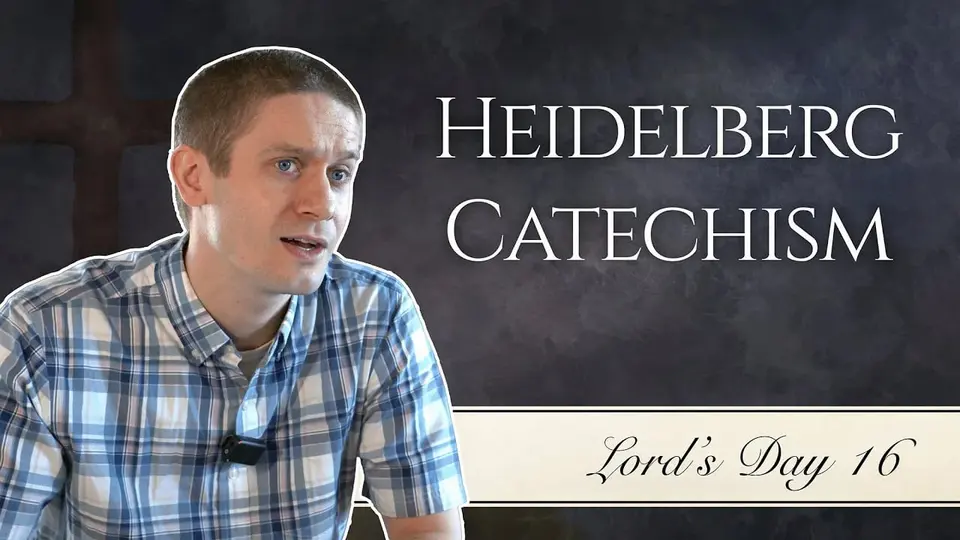
Lord’s Day 16 · Death & Burial
The Death of Christ Reformed Confessions 11 min January 31, 2025
Taught by
Ryan Swale Immanuel United Reformed Church, Jordan, Ontario Read along About Transcript
Q40 Why did Christ have to suffer death?
Because God’s justice and truth require it: nothing else could pay for our sins except the death of the Son of God.
Q41 Why was he “buried”?
His burial testifies that he really died.
Q42 Since Christ has died for us, why do we still have to die?
Our death is not a payment for our sins, but only a dying to sins and an entering into eternal life.
Q43 What further benefit do we receive from Christ’s sacrifice and death on the cross?
By his power our old man is crucified, put to death, and buried with him, so that the evil desires of the flesh may no longer rule us, but that instead we may offer ourselves as a sacrifice of thanksgiving to him.
Q44 Why does the creed add, “He descended into hell”?
To assure me during attacks of deepest dread and temptation that Christ my Lord, by suffering unspeakable anguish, pain, and terror of soul, on the cross but also earlier, has delivered me from hellish anguish and torment.
A growing library of films on the historic Reformed creeds and confessions. The Heidelberg Catechism is complete: all fifty-two Lord’s Days, taught by pastors from across the Reformed churches.
Ryan Swale is the pastor at Immanuel URC in Jordan, ON.
Free to watch, share and show in your church. Made by Faith to Film with the support of churches and believers.
0:00 - I had a break catechism, Lord’s Day 16. 0:12 Why did Christ have to suffer death? 0:16 Because God's justice and truth require it. 0:20 Nothing else could pay for our sins except the death of the Son of God. 0:26 Why was he buried? 0:28 His burial testifies that he really died. 0:32 Since Christ has died for us, why do we still have to die? 0:38 Our death is not a payment for sins. 0:40 but only a dying to sins and an entering into eternal life. 0:45 What further benefit do we receive from Christ's sacrifice and death on the cross? 0:52 By his power, our old man is crucified, put to death, and buried with him. 1:00 so that the evil desires of the flesh may no longer rule us but that instead we may offer ourselves as a sacrifice of thanksgiving to him and why does the 1:12 Creed add he descended into hell to assure me during attacks of deepest dread and temptation that Christ my Lord, by suffering unspeakable anguish, pain, and terror of soul on the cross, 1:28 but also earlier, has delivered me from hellish anguish and torment. 1:36 The first question in Lord’s Day 16 takes, us back to the very beginning of part two in our catechism where it speaks of God's justice and why no mere creature can bear the weight of God's wrath against sin and 1:52 deliver others from it. 1:55 It tells of how we need one who is not only true and righteous man, but who is also true God so that by the power of his divinity he might bear in his humanity 2:06 the wrath of God against sin. In other words it's saying the only way for our sins to be paid for is for the incarnate Son of God to suffer death. Genesis chapter 2:19 chapter 2 we read that the curse of sin is death. God told Adam that he ate of the tree of the knowledge of good and evil that he would surely die. And so the incarnate Son 2:31 of God, the one promised in Genesis chapter 3, comes and bears that curse for us, absorbing in his own body the eternal wrath. 2:39 of God against sin. The wrath of the Father is poured out on the Son so that we might not have to bear that wrath. That's ultimately what question 40 is speaking of. 2:53 As it moves on to question 41, it asks, why then was Jesus buried? The answer is, is that his burial testifies that he really died. 3:04 The real human body that the Son of God took upon himself really died. 3:10 As Paul says in 1 Corinthians chapter 15, was buried according to the scriptures. 3:16 And this was part of the prophetic revelation in the Old Testament that had to be fulfilled. 3:22 They show that Jesus really did die and that he really did take that curse, "From dust you are, and to dust you shall return," 3:31 even into the grave. 3:33 Isaiah 53 says that his grave would be made with the wicked The righteous one would be buried with sinners to show that the eternal Son of God, the only one who could pay for our sins, really did. 3:53 Which then leads into question 42 where the catechism asks, "Well, since Christ has died for us. 3:59 Why do we still have to die? 4:02 And it says that our death is not a payment for sins, but only a dying to sins and an entering into eternal life. 4:11 The fact that Jesus died doesn't mean that we don't die, but it means that death has lost its sting. 4:19 and has become for us an entrance into eternal life. 4:24 The worst aspect of the curse becomes in some ways a blessing, as it is an entrance into life eternal, into the presence of God. 4:34 Paul says that Christ's death takes away the sting of death. 4:39 So his death doesn't mean that we don't die, but it does mean that our death is not a payment for sin because that payment has already been made in full as Christ has borne the just 4:51 judgment of God in our place so that a payment for sin to be made by us is not necessary. 4:59 The catechism goes on in question 43 to say that not only has Jesus made full payment for our sin, but it says, "Also by his power our old man is crucified, put to death, and buried with him." 5:19 So the evil desires of Jesus. 5:19 of the flesh might no longer rule us but instead we may offer ourselves as a sacrifice of thanksgiving to him and saying the death of Jesus also means the 5:31 sinful desires of our flesh that once ruled us have been nailed to the tree and buried with him so it is Lord’s Day 17 will say, we are raised with him to new life. 5:43 The death and burial of Jesus not only make payment for sin, but are the death blow to our sinful nature that is buried with him. 5:51 So that we might offer ourselves as a sacrifice of thanksgiving, and there we think of the gratitude section later on in our catechism it's it's saying Christ's death is what makes 6:04 possible a life of Thanksgiving lived to God's glory and even in the trials of this life as Lord’s Day 9 reminds us that this life is is a veil of tears even in 6:19 that, the death of Christ also gives us comfort even in the midst of our trials. 6:25 That's what question and answer 44 reminds us and what I think is perhaps the most comforting and pastorally assuring question and answer in the catechism next to Lord’s Day 1, where, 6:39 Question and answer 44 now speaks about the descent into hell. 6:42 It isn't so much moving chronologically through the aspects of Christ's humiliation, but it takes up the question of the Apostles' Creed saying he descended into hell. 6:55 Our catechism understands that as speaking of the gravity of the things that Christ Christ suffered during all his life long and especially at the cross. 7:06 I'll read it. 7:07 It says, "Why does the creed add, 'He descended into hell?' To assure me during attacks of deepest dread and temptation that Christ my Lord, by suffering, I've noticed just a couple of things about that last question. 7:35 First of all, that it doesn't neglect the fact that we do have attacks of deep of deepest dread and temptation. 7:42 That the Christian life we live is a sharing with Christ in his suffering. 7:48 But then it tells us even in those dark moments that Christ our Lord has been there. 7:55 That he has suffered attacks of deepest dread and temptation too. 7:59 of the Garden of Gethsemane, or you think of Christ panting on the cross. 8:05 Hebrews speaks of him crying out loud shrieks of anguish. 8:10 All of this suffering, but especially on the cross, our catechism reminds us was Christ bearing the wrath of hell. 8:19 to deliver you from it and to comfort you in the midst of your suffering in this veil of tears that because of his anguish pain and terror of soul because of the hellish anguish 8:32 and torment that Christ suffered, not by literally descending into hell but by bearing the wrath hell on the cross by the things that he there suffered he guarantees that your 8:45 suffering and mine will one day cease as noticed three times question answer 44 uses that language of me and my it it wants to give us personal comfort I like to 8:59 Think of question and answer 44 alongside some of the lament psalms, Psalm 88 in particular. 9:08 It's been called the darkest prayer in all the Psalter, one long wail of sorrow from beginning to end. 9:16 It ends by saying darkness. 9:19 has become my closest companion. 9:24 The Word of God in places like Psalm 88 and the confessions of our church in places like question and answer 44 affirm that that's sometimes how we feel. 9:36 But it's almost as if question and answer 44 is reminding us Christ has sung Psalm 88 too Christ went all the way to the grave and and because he has because he has suffered in that way we can know that not only do 9:53 we have a companion in our suffering not only do we have a sympathetic Savior who the things that we suffer. 10:02 But we also have in him a guarantee that that suffering will one day cease as Christ himself has entered into it to deliver us from it. 10:13 That's the comfort of Lord’s Day 16. 10:16 It teaches us why Christ died and how the things But he then suffered assure us in our darkest moments that we have a Savior whose suffering means an end to all our hellish anguish and torment. 10:39 you Made automatically from the audio, so a word here or there may be wrong. Tap any line to play from there.
Study Lord’s Day 16 at reformedconfessions.org The full text, Scripture proofs, study questions and quizzes. 

 Now playing3 min

 Now playing8 min
 Now playing10 min
 Now playing9 min
 Now playing13 min
 Now playing8 min
 Now playing8 min
 Now playing9 min
 Now playing9 min
 Now playing9 min
 Now playing6 min
 Now playing9 min
 Now playing8 min
 Now playing8 min
 Now playing6 min
 Now playing8 min