Lord’s Day 50 · Daily Bread
Our Daily Bread Reformed Confessions 7 min February 12, 2026
Taught by
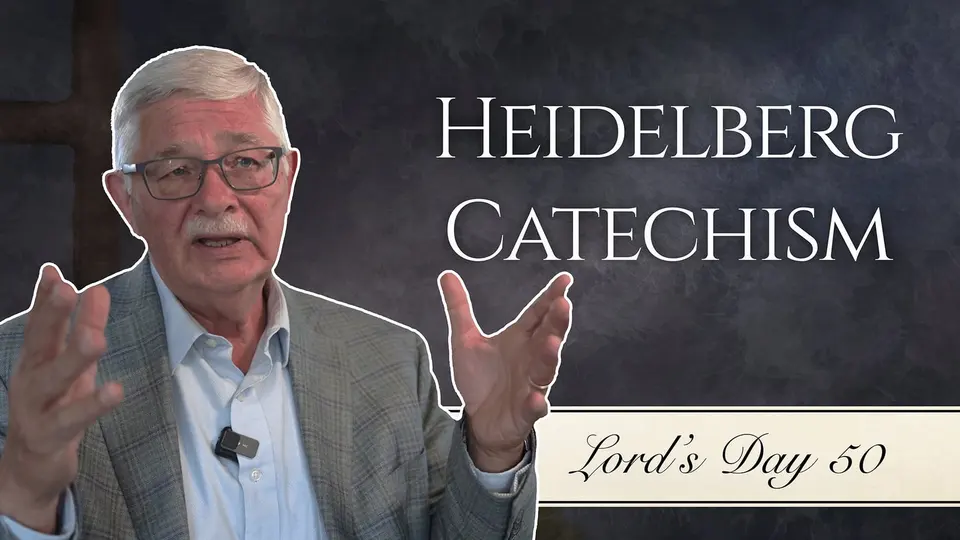
Dick Wynia Vineyard Canadian Reformed Church, Beamsville, Ontario Read along About Transcript
Q125 What does the fourth petition mean?
“Give us this day our daily bread” means: Provide for all our physical needs so that we may recognize that you are the only source of everything good, and that neither our care and work nor your gifts can do us any good without your blessing. Therefore may we withdraw our trust from all creatures and place it in you alone.
A growing library of films on the historic Reformed creeds and confessions. The Heidelberg Catechism is complete: all fifty-two Lord’s Days, taught by pastors from across the Reformed churches.
Rev. Dick Wynia is the pastor of the Vineyard Canadian Reformed Church in Beamsville, Ontario.
Free to watch, share and show in your church. Made by Faith to Film with the support of churches and believers.
0:00 The Fourth Petition The Fourth Petition Heidelberg Catechism, Lord’s Day 50. 0:11 What does the fourth petition mean? 0:14 "Give us this day our daily bread" means: "Provide for all our fifths." 0:20 physical needs, so that we may recognize that you are the only source of everything good, and that neither our care and work nor your gifts can do us any good without your blessing. 0:33 Therefore may we withdraw our trust from all creatures and place it in you alone. 0:40 This petition brings us to what might be called the, consider the second half of the Lord's Prayer. 0:46 There are three petitions that speak about God. We ask God to hallow his name and that his kingdom would come and that his will would be done. 0:57 And then we have three kind of us petitions. 1:00 our daily bread, forgiveness of our sins, and then that he would keep us from temptation. 1:07 And so some people reflect on that and kind of classify them, you might almost say as if Christ is teaching us to be polite. First ask for something for God before you ask for 1:20 something for yourself. There might be something in that, but I think we shouldn't miss the truth that in those first three petitions we are also asking 1:31 God for what we need and what we want. We want his name to be hallowed, to be glorified in ourselves, certainly in everywhere, and we want his kingdom to come in our lives and in this world. 1:43 And we want his will to be done by us and all creatures. 1:48 So in that sense, all the petitions are for us and all the petitions are for God. 1:54 I also think that Lord’s Day 50 takes a remarkable approach in many ways to this petition. 2:03 First of all, it broadens from daily bread to all our physical needs, provide for all our physical needs. 2:11 Christ in Matthew 6, when he warns us not to worry, he points out that we worry about food and drink. 2:18 We worry about clothing. 2:19 but he says your Father in heaven knows that you need all those things and thinking now about the way the Lord Jesus speaks in Matthew 6 combining that 2:30 with this petition remember that the Lord Jesus Christ is not just advising us hey this is how you could pray Christ commands us really, to ask God for our daily bread. He commands us not to worry, to put our 2:45 trust in God alone, which is essentially the first commandment, that we ought not to have any other God alongside of or in place of God that we invent or that we 2:55 have, and no other source that we should be looking to for anything that we need. Whenever I've preached on this Lord’s Day, whenever I teach this Lord’s Day, I'm always amazed at the insight that the authors of the 3:08 catechism, Olivianus and Arsenis, had into these kinds of things as young men. In their 20s they understood these things. And they point out this important 3:19 purpose of this petition. They don't say, for example, provide us with all our physical needs so that we stay strong, so that we stay healthy, so that we can do 3:32 our work, so that we can live and so forth. That's not even brought up in this answer. You could say that they present to us, or this answer presents to us, really, the spiritual reasons why Jesus 3:45 teaches us to make this petition. And the answer talks about the purpose of God giving us these gifts so that we would recognize that he is the only source of everything good, so that we would learn 3:59 from the meals we ate today, from the clothes we put on this morning, that we received from God, that we can rely on him, that we can trust in him. And that 4:11 makes us thankful, that makes us humble, that makes us look to him, that makes us turn our faith away from ourselves. 4:19 and put our trust only in him. 4:22 And this is what God teaches. 4:24 He taught Israel this, for example, in Deuteronomy 8. 4:27 And Deuteronomy is Moses' sermon there on the border before they entered the land of Canaan. 4:33 And he says, "Do you know why God lets you hunger in the wilderness, and then why he fed you with manna miraculously. 4:42 In verse 3 it says that he could teach you so that he would teach you, you would learn that your life does not depend on bread alone, but on every word that comes from the mouth of the Lord. 4:54 You had to learn that you depended on God's promises. 4:57 You had to learn to live by faith. 4:59 That's why I made you hunger and gave you manna. 5:02 Later in the same chapter, Moses says, God gave you the ability to get well, to confirm his covenant. 5:11 That has a, you see that these physical needs have a particular role to play in God encouraging us to live by faith in him, to be worshippers of God. 5:23 Acts 125 speaks about something else, teaches us another lesson. 5:29 It says that neither our care and work nor God's gifts can do us any good without God's blessing. Clothing and shelter, health and strength, these are all gifts of God, all 5:46 good gifts. None of those things does us any good without God's blessing. 5:53 And so, answer 125 doesn't just say that we depend on God's blessing for for our work to be successful, although that is very true. 6:04 But answer 125 is saying that unless we learn that lesson, that God is the only source of everything good, unless our food and drink and clothing and shelter and all these things 6:19 teach us and encourage us and lead us to be thankful people who put their trust in God alone. 6:28 Those things haven't done us any good. And so in a way, in its closing words, answer 125 is really capturing what we confess is the meaning of the fourth petition, what we are asking. 6:41 We are asking God, may we withdraw our trust from all creatures and place it in you alone. 6:59 Thank you. Made automatically from the audio, so a word here or there may be wrong. Tap any line to play from there.
Study Lord’s Day 50 at reformedconfessions.org The full text, Scripture proofs, study questions and quizzes. 



 Now playing3 min
 Now playing8 min
 Now playing10 min
 Now playing9 min
 Now playing13 min
 Now playing8 min
 Now playing8 min
 Now playing9 min
 Now playing9 min
 Now playing9 min
 Now playing6 min
 Now playing9 min
 Now playing8 min
 Now playing8 min
 Now playing6 min
 Now playing11 min