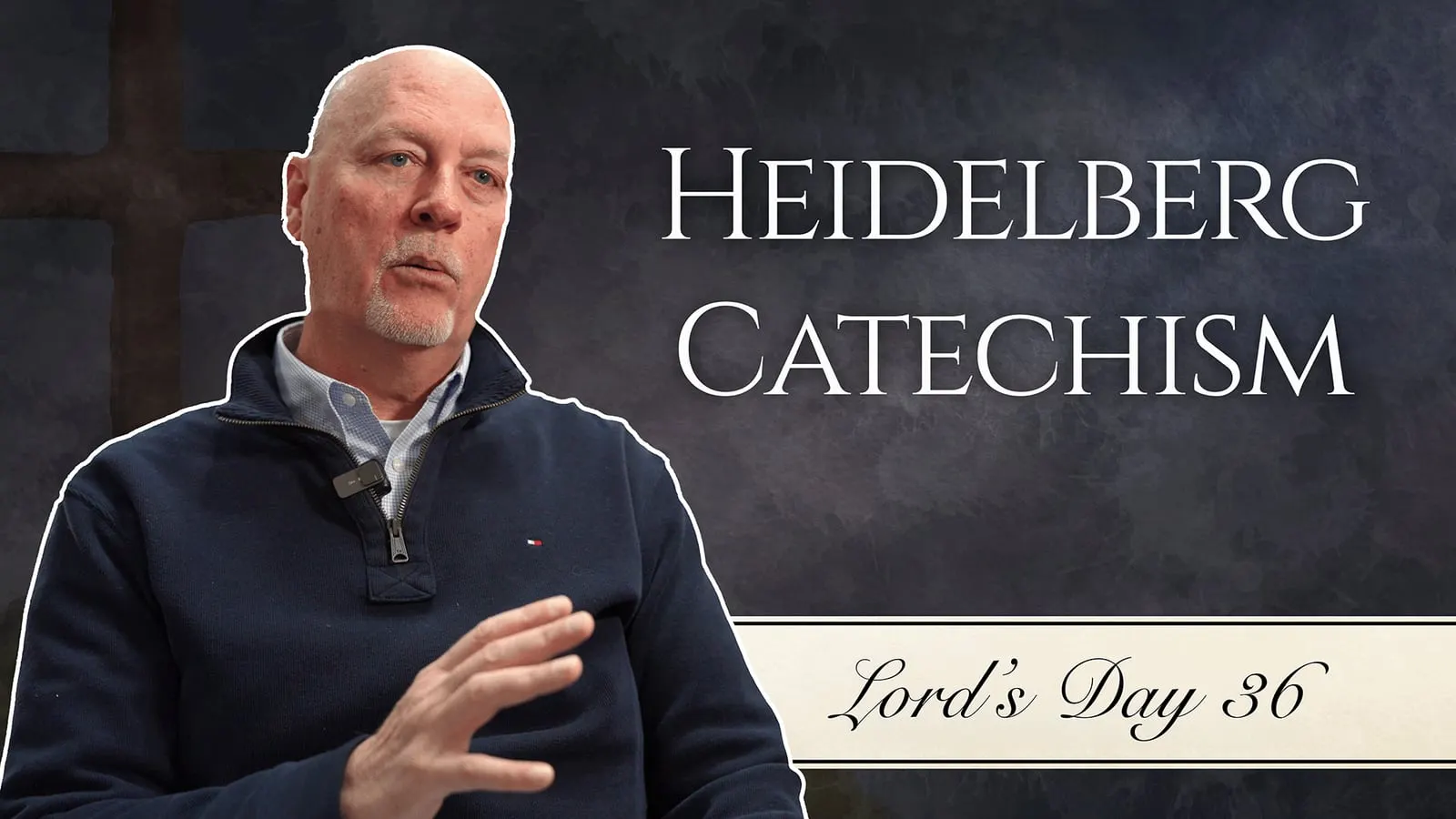
Lord’s Day 36 · The Third Commandment
The Greatest Sin Reformed Confessions 7 min March 31, 2026
Taught by
Keith Davis Bethel, Calgary, Alberta Read along About Transcript
Q99 What is God’s will for us in the third commandment?
That we neither blaspheme nor misuse the name of God by cursing, perjury, or unnecessary oaths, nor share in such horrible sins by being silent bystanders. In summary, we must use the holy name of God only with reverence and awe, so that we may properly confess him, call upon him, and praise him in everything we do and say.
Q100 Is blasphemy of God’s name by swearing and cursing really such serious sin that God is angry also with those who do not do all they can to help prevent and forbid it?
Yes, indeed. No sin is greater or provokes God’s wrath more than blaspheming his name. That is why he commanded it to be punished with death.
A growing library of films on the historic Reformed creeds and confessions. The Heidelberg Catechism is complete: all fifty-two Lord’s Days, taught by pastors from across the Reformed churches.
Rev. Keith Davis has served as Bethel’s Pastor since January 23, 2015, after being ordained in 1998 following his graduation from Mid-America Reformed Seminary. Now marking over 20 years in pastoral ministry, he views this as a testimony to God’s faithfulness, echoing the spirit of “Ebenezer”: “Thus far has the Lord helped us” (1 Samuel 7:12). Before Bethel, he pastored two congregations in the United States. He and his wife Laura, originally from Illinois, have seven children and five grandchildren. While moving to Calgary meant leaving family behind, they have been deeply blessed and enjoy serving their church community. His hobbies include tennis, golf, chess, fishing, and organizing the annual Summit Reformed Youth Conference, one of his favorite weeks of the year.
Free to watch, share and show in your church. Made by Faith to Film with the support of churches and believers.
0:00 The Old Testament The Old Testament The Old Testament The Old Testament The Old Testament Heidelberg Catechism, Lord’s Day 36. 0:12 What is God's will for us in the third commandment? 0:16 That we neither blaspheme nor misuse the name of God, by cursing, perjury, or unnecessary oaths, nor share in such horrible sins by being silent bystanders. 0:28 In summary, we must use the holy name of God only with reverence and awe, so that we may properly confess him, call upon him, and praise him in everything we do 0:40 and say, "Is blasphemy of God's name by swearing and cursing really such serious sin that God is angry also with those who do not do all they can to help prevent or forbid it? 0:53 Yes indeed, no sin is greater or provokes God's wrath more than blaspheming his name." 1:00 That is why he commanded it to be punished with death. 1:04 So this Lord’s Day concerns the implications and the applications of the third commandment, that we're not to take the name of the Lord our God in vain. 1:14 How we talk, how we use God's name in conversation, perhaps even in expressions of joy, and surprise and even in anger that we don't take God's name upon our lips in 1:24 ways that would be an offense to him. But what always amazes me whenever I read this Lord’s Day and consider it and even as a reflection of my own life 1:34 and my own heart is what that second question and answer gets at by looking at this is saying, does this command, or rather, is this blasphemy, is this cursing and swearing 1:46 such an offense to God, such serious sin, that God is angry with it or even more angry than he is with any other sin that we commit? And the way the answer puts it, no sin is greater or provokes God's wrath more. 2:02 The reason I reflect upon that especially is because I think of all the other sins, all the other commandments and the sins that they address. 2:09 And we get down in the commandments of God, we're dealing with murder and we're dealing with subjects of personal purity and single life and married life. 2:18 And what about sins of covenant? 2:19 or lying. And yet you come back to this and go, "Well, why then does this Lord’s Day say that? What's the point here?" And I believe it must be because of this, because 2:28 this commandment is addressing the person of God. It's who he is in terms of his essence, his being, because his name is a representation of all that he is and of all all that he does. 2:41 And so to take God's name upon our lips in any way that's mocking or flippantly using it or using it in a lighthearted way, it's a mockery. 2:50 It's really an assault, it's an attack, it's an offense against the very nature and being of God. 2:56 And so we come to maybe some practical considerations of What are ways in which we see this third commandment being broken or even transgressed out there in the world, 3:06 but also in our lives? And I think, for example, of the sin of blasphemy. 3:10 I think of the fact that people, even Christians, would claim that if Jesus were alive today, he would be the one leading the gay pride parade. And other people would talk about about Jesus in terms of an even God, 3:22 or my God, they personalize it as if their understanding of God was something specific to themselves. 3:28 My God would never do that. 3:30 My God would never cast people to hell. 3:32 My God would never enter into judgment against others based upon their orientation. 3:38 And so we see in our society remaking of God in our own image, which is blasphemy. It's a lie about God, where they believe that lie in themselves, not only that, but they make it worse. They 3:48 want others to believe that lie also. But then we bring this a little bit more closely to our own lives and to some of the ways in which we, as it says here, we might also use God's name 3:59 in vain by cursing or swearing. The lighthearted use of God's name. Sometimes Christians lose their temper and they damn people or they damn things. Well, that's a violation of this 4:11 commandment. Other times we might think we're saying things in jest or we just go, "Ah, jeez." And we grew up with that too, where people say, "Well, you know, when you say 4:19 "Jeez, what do you mean?" You're really saying Jesus or Jesus Christ. So that's a form of violating the third commandment. 4:26 So we see even in those ways we can be guilty of that. 4:29 Whenever we're conversing with God, our words and phrases should be thought out, they should be sincere, not just routine phrases. 4:37 We're not just to throw around even names. 4:39 names like the Lord God or God or good God, great God, things like that that we can just use as filler, as words that might make our prayer sound more eloquent or even pietistic, 4:52 but really just be sincere in our prayers and every thought and word that we say in prayer. And then there's perjury where we're sworn where we're to take an oath in God's name. 5:01 We swear by God's name that we tell the truth, but we break that oath. 5:06 We intentionally lie under oath, or even unnecessary oaths. 5:11 Sometimes we joke about, "I swear in my mother's grave," 5:14 because we want to make sure that someone really believes that what we're saying is true. 5:17 We take an unnecessary oath. 5:19 oath. The next Lord’s Day points us to oaths that we can take that are biblical, but these are unnecessary, even vain oaths that we're taking. And of course, sharing in such horrible sins as 5:31 being silent bystanders. And how many of us have been in that situation where perhaps a friend or even at a ballgame where someone is just shouting out the Lord's name in vain, and 5:39 the name Jesus Christ or something in a very, a way that makes us cringe, how do we go about prayerfully, gently rebuking them or maybe taking them to the side 5:52 quietly and saying, "I'm a Christian and your use of God's name in that regard is great offense, not just to me, but to God in me." 5:59 So just to ask you to refrain from speaking like that, for sure, when you're around me, but hopefully always. 6:08 And I think especially when we take that last phrase of this Lord’s Day and we turn that around a moment, maybe this can be an encouragement to us all, that if it's true, as it says, 6:19 greater or provokes God's wrath more than blaspheming his holy name, then it must also be true that nothing brings God more delight, nothing brings God more pleasure and joy than 6:32 when we, his people, we live according to his commandments and we walk in his ways and we bring him honor and glory. 6:39 with all that we say and do and think. Made automatically from the audio, so a word here or there may be wrong. Tap any line to play from there.
Study Lord’s Day 36 at reformedconfessions.org The full text, Scripture proofs, study questions and quizzes. 



 Now playing3 min

 Now playing8 min
 Now playing10 min
 Now playing9 min
 Now playing13 min
 Now playing8 min
 Now playing8 min
 Now playing9 min
 Now playing9 min
 Now playing9 min
 Now playing6 min
 Now playing9 min
 Now playing8 min
 Now playing8 min
 Now playing6 min
 Now playing11 min