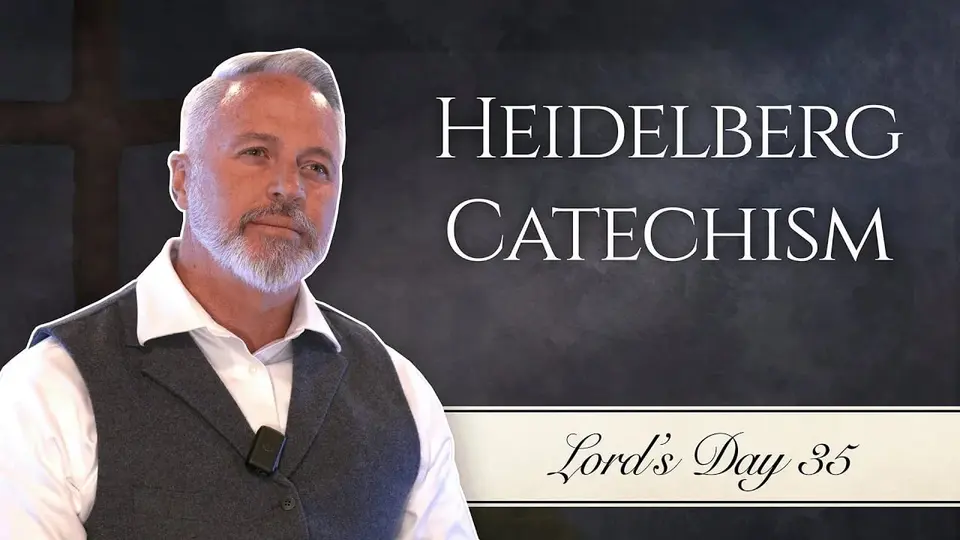
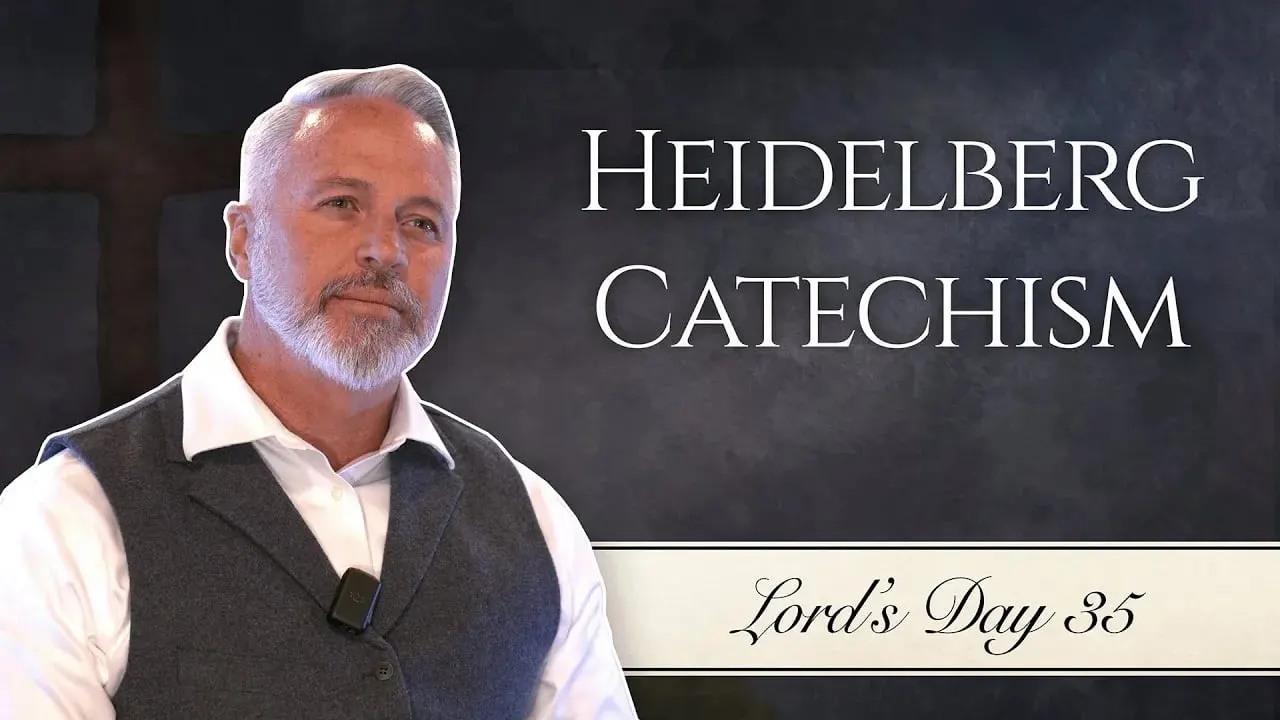
Lord’s Day 35 · The Second Commandment
Are Pictures of Jesus Okay? Reformed Confessions 12 min October 3, 2024
Taught by
Christopher Gordon Escondido United Reformed Church, California Read along About Transcript
Q96 What is God’s will for us in the second commandment?
That we in no way make any image of God nor worship him in any other way than has been commanded in God’s Word.
Q97 May we then not make any image at all?
God cannot and may not be visibly portrayed in any way. Although creatures may be portrayed, yet God forbids making or having such images in order to worship them or serve God through them.
Q98 But may not images, as books for the unlearned, be permitted in churches?
No, we should not try to be wiser than God. He wants the Christian community instructed by the living preaching of his Word — not by idols that cannot even talk.
A growing library of films on the historic Reformed creeds and confessions. The Heidelberg Catechism is complete: all fifty-two Lord’s Days, taught by pastors from across the Reformed churches.
Rev. Christopher Gordon was ordained to the Ministry of the Word in October 2004. Rev. Gordon is a native of Central California, and prior to answering God’s call into the ministry, he was a high school Bible teacher in the central Californian valley. Rev. Gordon, having a love for Reformed theology, pursued further theological studies and received his Master of Divinity degree from Westminster Seminary in Escondido, CA, where he studied under such scholars as Drs. Michael Horton, W. Robert Godfrey, R.S. Clark, S.M. Baugh, David VanDrunen and D.G. Hart. He pastored at the Lynden United Reformed Church from 2004 to July 2012, and is presently Preaching Pastor at the Escondido United Reformed Church.
Free to watch, share and show in your church. Made by Faith to Film with the support of churches and believers.
0:00 Heidelberg Catechism, Lord’s Day 35. What is God's will for us in the second commandment, that we in no way make any image of God, nor worship Him in any other way than has been commanded in God's word. 0:24 May we then not make any image at all. 0:27 God cannot and may not be visibly portrayed in any way. 0:31 Although creatures may be portrayed, yet God forbids making or having such images in order to worship them or serve God through them. 0:40 But may not images as books for the unlearned be permitted in churches? 0:45 No, we should not try to be wiser than God. He wants the Christian community instructed by the living preaching of His Word, not by idols that cannot even talk. 0:57 Heidelberg Catechism will Lord’s Day 35 is a very important section for us considering the law of God and especially the second commandment as it addresses the second commandment specifically. 1:11 This commandment in the history of the church has always found a lot of debate and discussion around the question of images. 1:20 And the Heidelberg Catechism deals directly with that question, which I find incredibly helpful for us. 1:26 We live in a day of great media advancement. 1:28 We live in a day of social media. 1:31 Images are constantly flashing in front of us. 1:33 So for moderns, this might seem even shocking that there would be a reformed standard that deals with the moderns. 1:39 with the question of can we make images of Jesus? Can we make images of God? And the Heidelberg Catechism, Lord’s Day 35, directly deals with this question, I think, in a very 1:50 important way. The first thing that the commandment addresses is that it asks the question, what is God's will in the second commandment? And it's instructing us 1:59 about the question of images, whether we are able to make an image of God and the commandment expressly forbids this. It expressly forbids making an image of God 2:11 or worshiping Him in any other way than has been commanded in God's Word. 2:17 Let's start with the second part to that. 2:19 which I think is important, that there is a regulative principle of worship. 2:24 That is something that is explicitly commanded in how we are to worship God. 2:29 He has instructed our worship. He has called us and told us how to worship Him explicitly in His Word by way of command. And that has a great principle 2:39 purpose. That keeps us from error. That keeps us from idolatry. That keeps us from what Colossians calls is will worship. That keeps us from being self-serving in worship. It 2:50 protects us, right? The commandment is intending to protect us from the great problem of idolatry and making God into something other than who he is and how he's been revealed in his word and how we are to 3:05 approach God in his holiness and his greatness. That's a very important point to make with regard to the second commandment. God is in charge of his own 3:14 worship. It would be a rude thing for me to come into somebody's house and dictate the terms of my stay there. 3:23 We wouldn't do that. 3:24 Even in sort of natural life, it would be offensive for me to come into somebody's house and dictate the terms of my stay. 3:32 What I want to eat, how I want to live, what I want to do. 3:35 There's no respect for the person's house in that regard. 3:38 Think of the great God of heaven and earth who has forgiven our sins and made a glorious way for us to come in the gospel to him to worship him. The problem is since sin still remains in us, our 3:51 worship has to be regulated. And that's what the Heidelberg Catechism is directly addressing in the second part of that first question. 3:59 answer. Now we come to the very, I think, helpful and controversial section of Lord’s Day 35, which deals with the question of whether we are able to make images. What is God's will 4:15 for us in the second commandment? That we in no way make any image of God. 4:19 Living in our day with a lot of technological advancement, we're used to images. 4:23 We live with images. 4:25 We think we couldn't even imagine to think that there would be any problem with this. 4:29 However, if you look at the history of the church, image making has always gone on. 4:33 And if you look particularly, I think there was a book years ago that was written that cataloged the many different images made of Jesus throughout the centuries. 4:42 And it was amazing how many different representations were made. 4:45 You had a white Jesus, you had a black Jesus, you had an Asian Jesus. 4:50 You had Jesus according to the cultural norms of the time, a kind of tough guy, Billy Sunday Jesus. 4:55 You had a Jesus who was a very effeminate Jesus according to the Victorian era. 4:59 of the 19th century. All of these were gross idolatries because they all were making Jesus into the image of somebody at the present time that wasn't Jesus. I 5:14 think that's the great issue of the second commandment. Our hearts as Jesus John Calvin said are idol factories. 5:22 We are good at worshiping and making images to worship with. 5:26 The whole problem existed in Exodus 32 when Israel came out and made an image to worship, calling it Yahweh. 5:33 The Lord has explicitly forbidden this. 5:37 And I suppose the question is why? 5:39 Why has the Lord told us? 5:41 I often hear with regard to this commandment, well, as question 97 says, may we not then make any image at all? 5:48 God cannot and may not be visibly portrayed in any way. 5:51 Although creatures may be portrayed, yet God forbids making or having such images in order to worship them or serve God through them. 5:58 There's the question. 5:59 Well, what if I'm not worshiping God with them? 6:04 What if I have chosen not to serve God through them? 6:06 Am I not able then to make an image? 6:10 And my question to everyone is, what image of God do you have? 6:16 He has an inspired one. 6:18 It's not like the first century have done that. They were great in the visual arts. They could have produced, Jesus could have inspired in His Word, an image for us to adore. Why didn't He do 6:28 that? Any image de facto becomes something that we create of our own imagination of Him. That is not Him. That's the point. He has not left us with an inspired 6:39 image. So take this scenario. I have a wonderful wife, beautiful wife. Let's say I'm on a trip and I don't have an image of my wife with me. And I pull out an 6:52 image out of a magazine and I hold it up to someone and say, "This is my wife." I pick a beautiful image image. This is my wife. What's the problem with that? It's not my wife. And what an offense 7:06 to her that I'm passing around an image that is not her. So we don't even have the ability to make an image is the point I would like to make with people. What we're doing then 7:16 is creating a Jesus according to our own imagination. 7:19 And then we box him into a particular race or culture at a particular point in time that is not fair to any other people group if you're going to look at it that way. 7:29 Jesus in his incarnation was a Jewish man who took on a Jewish human nature, if you will. 7:38 But that incarnation... 7:39 in that incarnation, we have to remember that as Isaiah describes, He has no comeliness that we should desire Him. It's not that we ever looked, anyone ever looked upon Jesus 7:53 and saw in Him the greatness of who He was in the very incarnation of the body that He There was great humility in that. 8:02 Why? 8:04 Because Jesus doesn't want us worshiping throughout history by graven images. 8:11 He wants us worshiping him by faith in this present age. 8:16 That's the important point I think I'd like to make with this. 8:19 We are called not to live by sight, but by faith. 8:24 And faith that is given to us by the powerful message preached. 8:31 So notice that in question answer 98, "But may not images as books for the unlearned "be permitted in churches. 8:39 This is a great question and answer in 98. 8:43 No, we should not try to be wiser than God. 8:47 He wants the Christian community instructed by, crucial point to the second commandment, the living preaching of the word. 8:55 It's the word that orders our worship and keeps us from breaking the second commandment. 8:59 It's the Word that commands our worship, but it's the Word that also shows us Jesus. 9:07 It's that Word that by the Word by which we see Jesus in the gospel preached. 9:14 That is the means He has given through this present age to make known the name of Jesus Jesus and to by faith show him as he is embraced in hearty trust and embraced in the gospel of his great power. 9:30 So the second commandment specifically is condemning the action of making images because one of the great benefits and blessings held out for the Christian is what we call the 9:44 beatific vision. The beatific vision is on the last day when we have resurrected bodies with resurrected eyes, the reward that we are promised is that we will gaze our 9:59 resurrected eyes on the resurrected Savior and see him in glory forever, our mediator. 10:07 In the present age, the age of suffering and affliction, we see him by faith. In glory, we look upon him by sight. That's the pattern of this present age and how we are to live. 10:22 And that's why the second commandment is regulating this. 10:26 That's why we don't carry around, by the way, crucifixes, where Jesus is still on a cross. 10:33 The only image we have of Jesus in scripture is Revelation 1. 10:39 which is entirely symbolic. He's in resurrection glory and you could never draw it. It's communicating His sheer power, His glory, that He is our divine warrior and that we in this present 10:52 age are to live by faith as we wait for Him to come again. Then He will take us to be with Him and we will have His glory. 10:59 with our resurrected eyes the ability to see Him. So the second commandment regulates this in our lives. It expressly forbids this so that we don't fall into idolatry. And it helps 11:10 us and orders us so that we would worship God properly for His glory, for His great name, for His kingdom, for His purposes. As we learn to adore Him as He has revealed Himself in this present age through His Word. Made automatically from the audio, so a word here or there may be wrong. Tap any line to play from there.
Study Lord’s Day 35 at reformedconfessions.org The full text, Scripture proofs, study questions and quizzes. 

 Now playing3 min

 Now playing8 min
 Now playing10 min
 Now playing9 min
 Now playing13 min
 Now playing8 min
 Now playing8 min
 Now playing9 min
 Now playing9 min
 Now playing9 min
 Now playing6 min
 Now playing9 min
 Now playing8 min
 Now playing8 min
 Now playing6 min
 Now playing11 min